Your rental EV is empty, but the rental company still owns it. Contact the rental company before approving roadside work when it’s safe. Then compare its instructions with available charging or towing options.
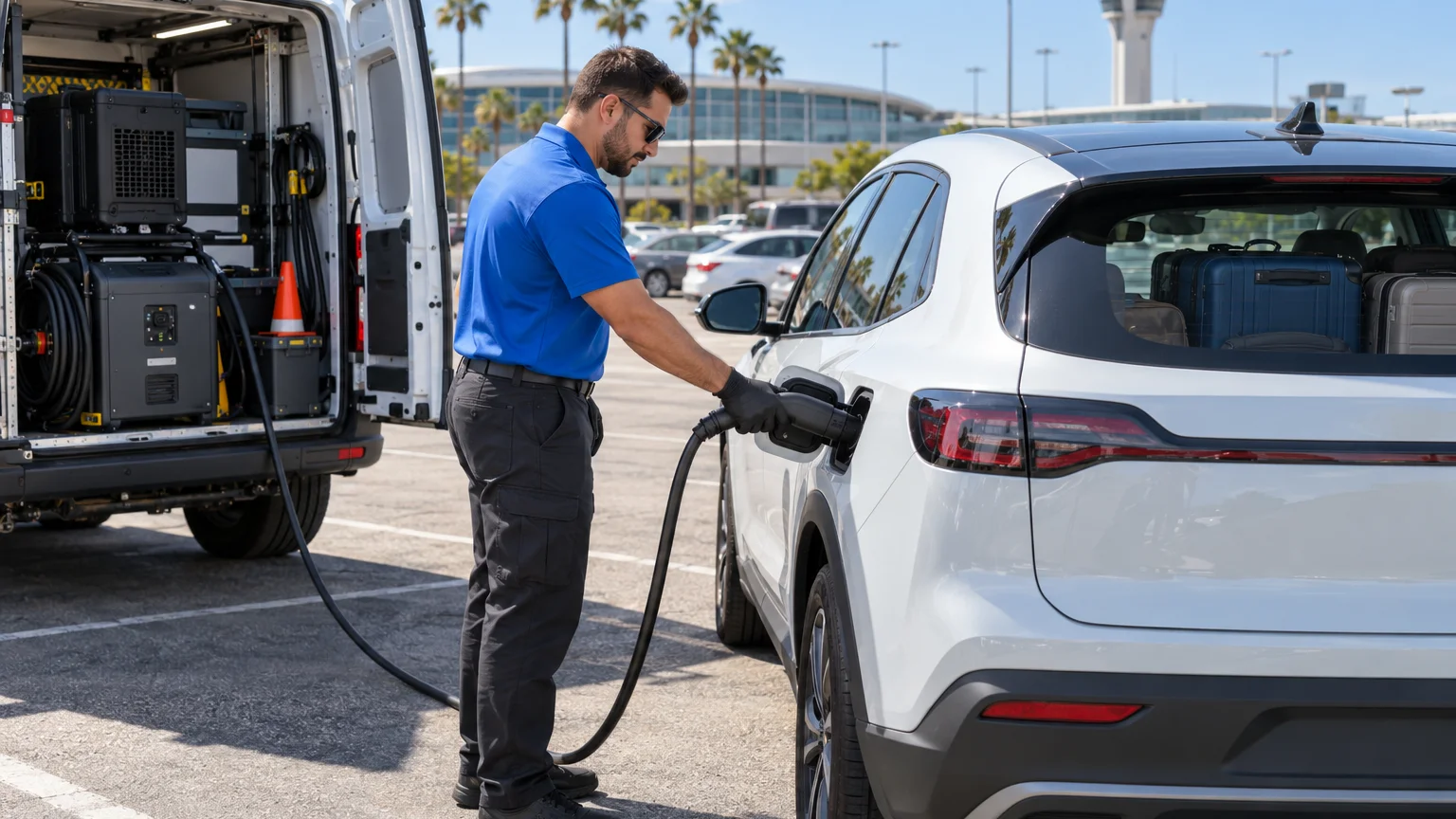
Charge Pro OC can connect you with a licensed, independent local operator. The operator performs the work, quotes the service, and bills you directly. We don’t charge, tow, or repair the rental vehicle.
Separate an empty pack from a dead 12V
Start with the last thing the car displayed. A remaining-range reading near zero points toward an exhausted traction battery. A car that won’t wake, unlock normally, or display its range may present a different problem.
Don’t treat every unresponsive rental EV as an empty main battery. A low-voltage battery problem and an exhausted traction pack call for different help. A jump to the low-voltage system doesn’t refill the traction battery.
Tesla’s Model Y manual provides one documented example. Once the vehicle’s range is exhausted, its low-voltage battery loses support. An external power supply may then be needed before the high-voltage battery can charge. That detail applies to the documented Tesla procedure, not every rental EV.
Check the display, rental app, key card, and any warning message. Write down the exact wording without clearing notifications. If the car still shows usable range but won’t start, don’t describe it as simply empty. Tell the rental company and roadside operator what the screen shows.
Our guide to an electric car that died explains how charging, a low-voltage jump, and towing address different symptoms. The rental company may also have model-specific instructions in its agreement or app.
Avoid disconnecting batteries, opening service panels, or trying undocumented reset sequences. You don’t own the vehicle, and the rental company may control what work it authorizes. A clear symptom report helps everyone choose the next step without guessing.
Check the rental agreement before approving roadside work
A rental EV creates an ownership and authorization issue. The roadside decision isn’t based only on what can make the car move. It also depends on what the rental company permits.
Coverage terms couldn’t be confirmed for rental EVs as a group. Each company sets its own agreement, roadside process, payment rules, and return instructions. Check the current agreement or contact the rental company before accepting work when your location is safe.
Ask the rental company several direct questions:
- Does it want the vehicle charged where it sits or towed?
- Must roadside service come through its own provider?
- Can you approve an independent mobile charging operator?
- Where should a tow take the vehicle?
- Who pays the operator at the scene?
- What records are needed for a possible reimbursement request?
- Does the return location need notice before the vehicle arrives?
Don’t assume a roadside benefit covers charging, towing, storage, or a missed return. No general rental-company coverage rule was confirmed for this page. Get the current answer from the company that issued your agreement.
This matters around John Wayne Airport and Anaheim resort-area lots. You may be close to the rental return location but unable to move the vehicle. The rental company may prefer one destination or recovery method. Confirm that preference before authorizing an operator.
If you can’t reach the rental company and the car creates an immediate road hazard, contact emergency services. Safety and traffic control come before contract questions. Once the immediate danger is handled, document what happened and continue trying the rental company.
Record the car, location and remaining range
Good records reduce confusion between you, the rental company, and the operator. Capture the vehicle and location before the screen changes or the car loses more power.
Photograph the dashboard, remaining range, warning messages, charge-port area, and the vehicle’s position. Include a wide photo showing nearby landmarks. Don’t publish or share personal rental documents beyond the parties handling the incident.
Record the vehicle make and model. Note the license plate, rental agreement number, and return location for the rental company. For the operator, share the charging connector type only if you can confirm it from the car or rental paperwork. Don’t guess based on appearance.
Location details matter across Orange County. “Near the airport” isn’t enough. A vehicle inside a John Wayne Airport-area parking structure presents a different access problem than one on an I-405 shoulder. The same applies to an Anaheim resort-area lot versus an I-5 breakdown.
Send the operator the structure name, floor, section, entrance, and clearance information when posted. In an open lot, provide the nearest marked row or storefront. On a freeway, give the route, direction, nearest exit, and whether the vehicle is fully outside a traffic lane.
California requires warning lights to flash when a disabled vehicle is on the roadway, if the device still works. A vehicle obstructing traffic or creating a hazard may be removed immediately. If you’re exposed to moving traffic, contact emergency services rather than walking around the car for photos.
Also record the time you contacted the rental company and its instructions. Save messages and receipts. Documentation doesn’t promise reimbursement, but it gives the rental company a clear record to review.
Compare a mobile charge with the rental company’s tow plan
A mobile charge may fit when the traction battery is empty, the vehicle can accept a charge, and the rental company approves that approach. The goal is enough usable range to reach an approved charging or return location.
The approved rescue-charge figure is 10 to 20 miles of range from 15 to 30 minutes of Level 2 charging. That figure describes charging time, not an operator’s arrival time. Actual results still depend on the vehicle and charging conditions.
Out-of-charge EV recovery can connect you with an independent operator who evaluates the vehicle at its location. The operator quotes and bills you directly. Charge Pro OC doesn’t set the price or promise an arrival time.
A tow may make more sense when the rental company requires it. It may also be the requested plan when the vehicle won’t accept a charge or its condition remains unclear. Confirm the destination before the tow begins. A nearby charger may not be the rental company’s approved destination.
The practical differences are covered in our mobile charge or tow comparison. Use that comparison alongside the rental company’s current instructions, not as a replacement for them.
Freeway locations add another layer. Orange County’s Freeway Service Patrol lists towing to a CHP-designated drop zone among its limited services. Its published service list doesn’t include EV charging, and assistance isn’t guaranteed. Published coverage information also conflicts between OCTA’s webpage and fact sheet.
An independent operator may still be needed after a vehicle reaches a safer location. Our EV roadside assistance service connects drivers with licensed local operators for the specific problem reported.
Confirm payment and return instructions before leaving
Before work starts, confirm who is authorizing it and who must pay. Charge Pro OC doesn’t set prices. The independent operator provides the quote and bills the driver directly.
Ask for a written description of the proposed service. Confirm whether it covers mobile charging, a low-voltage jump, towing, or diagnosis at the vehicle. These aren’t interchangeable services.
If the rental company says it may review the expense later, ask what documentation it needs. Don’t treat a possible review as guaranteed reimbursement. Save the operator’s invoice, the rental agreement, photos, and the rental company’s written instructions.
After a mobile charge, confirm where the rental company wants the vehicle taken. The answer may be a rental return, an approved charger, or another location. Don’t assume the nearest charging station satisfies the return plan.
Before leaving a parking lot or structure, check posted exit and access instructions. No universal rule or fee for John Wayne Airport-area or Anaheim resort-area parking could be confirmed. The property or facility sets its current procedures, so check posted information or contact its operator.
If the vehicle is towed, write down the destination before it leaves. Send that information to the rental company. If another driver is listed on the agreement, keep that person informed as well.
Once the vehicle reaches the instructed location, photograph its position and displayed range. Confirm whether the rental company considers the roadside issue resolved. That final check can prevent a mobile charge from becoming a separate return dispute.
When to call us
Call when the rental company permits independent roadside help and the EV needs an on-site charging operator. We can also connect you with an operator when the failure type remains unclear and the rental company has approved local assistance.
Call us at (949) 444-0151 and we’ll connect you with a local EV rescue operator.