Searching for 24 hour EV charging near me usually returns chargers whose listings appear open all day. It does not prove that the parking structure is unlocked, the cable fits your car, the stall is working, or a session can start tonight. Before you move a low EV, confirm the site in the network app, check the property entrance and posted signs, and read the stall screen.
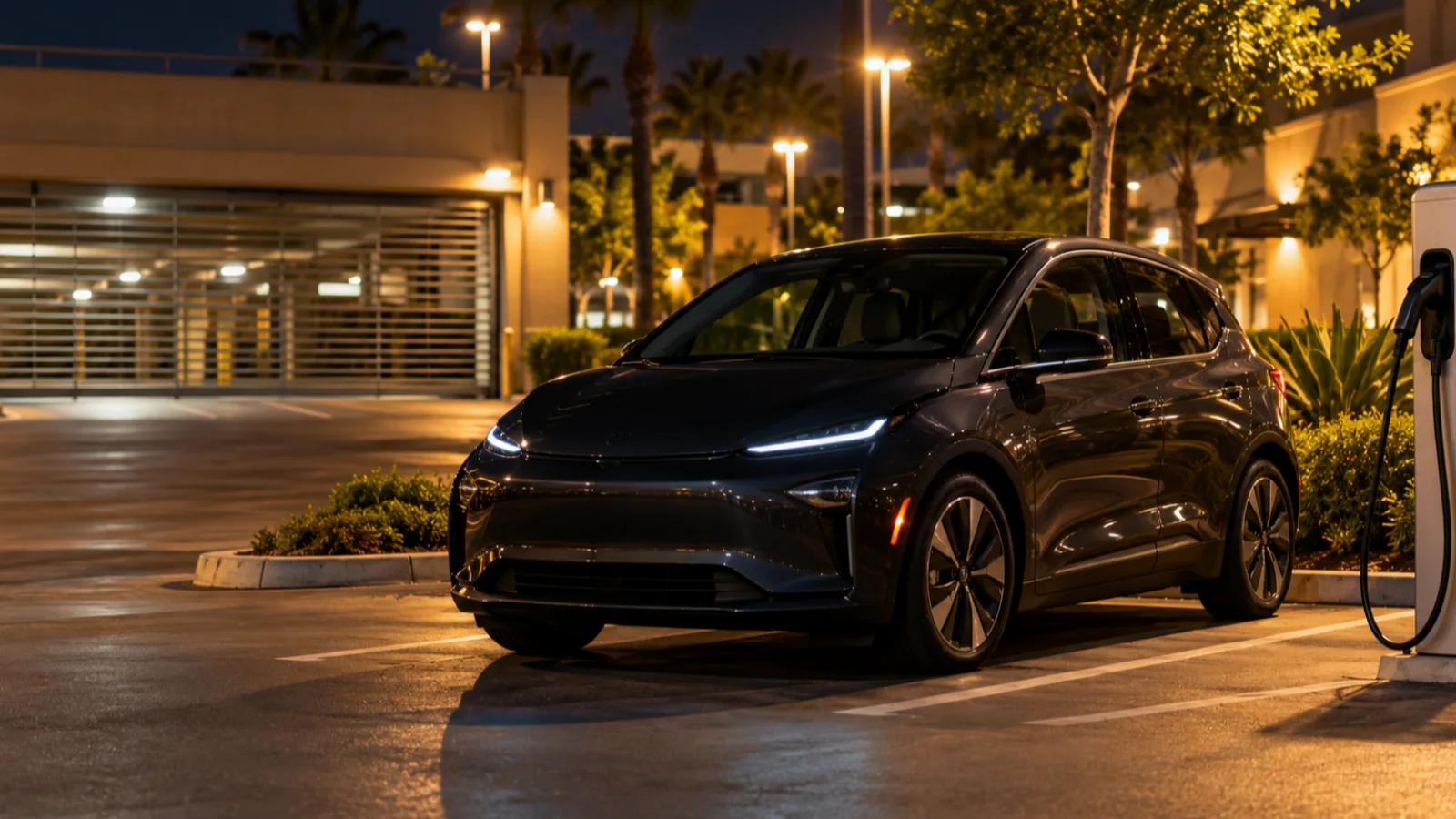
What 24-hour EV charging near me usually returns
The result may be a public DC fast charger, a Level 2 plug in a shopping center, or a charger inside a garage. The map pin describes the charger listing. Access belongs to the property around it.
That distinction matters after dinner near Disneyland-area lots, South Coast Plaza structures, Irvine office parks, HOA garages, and beach parking. A charger may still appear on a map when a vehicle gate is closed. A garage can have its own parking rules. An HOA charger may be for residents or approved guests. A beach lot may close according to its posted schedule even when the charging network still displays the pin.
Do not infer overnight access from the words “open now.” Open the exact site card. Look for recent driver check-ins, access notes, connector details, and any notice from the network. Then compare that information with signs at the entrance. The sign and gate in front of you control whether you can enter.
Orange County had 7,095 public charging ports as of December 31, 2025, according to the California Energy Commission. Of those, 5,600 were Level 2 and 1,475 were DC fast ports. Those counts describe installed public ports, not which gate is open at midnight or which stall is working right now.
If the charger screen is dark or the session will not start, use the checks in what to do when a public EV charger is not working. Try the neighboring stall if one is available, reseat the connector, and check the network app before spending range on another lot.
Confirm overnight access before you drive
Make the decision while parked, especially if the range display is already low. Check these four layers:
- Property access. Look for a garage gate, lot closing notice, permit rule, valet restriction, or resident-only sign.
- Live network status. Open the charging network’s own app. A map aggregator is useful for recent notes, but the network app is closer to the session you are trying to start.
- Connector fit. Confirm NACS, CCS, or J1772 and make sure the adapter you need is in the car.
- A second reachable option. Do not leave for the first pin unless you can identify what you will do if that stall is occupied or offline.
The car’s navigation, PlugShare, and the network app may disagree. That is a reason to cross-check, not a reason to gamble the last miles. No live overnight access could be confirmed for every Orange County listing on this page. Hours and gates change by property, so this is not a directory of all-night stalls.
If the first stall is dark, stay parked long enough to verify the next one. A pin across Costa Mesa may sit in another structure with another gate. An Irvine charger can be inside an office or residential property. A charger near the coast can be beyond a lot entrance with posted closing rules. Straight-line distance does not tell you whether you can enter and start a session.
For a broader setup before the battery gets low, mobile EV charging near you in Orange County explains how a referral works when the car cannot reach a usable plug.
Overnight 12V failure versus an empty traction pack
A car that will not wake after sitting overnight may not need traction-pack charging at all. EVs have a high-voltage traction pack that moves the vehicle and a separate low-voltage battery that powers computers, locks, screens, and the systems needed to start the car.
Think about what the car showed when you parked.
- If the EV had usable range, then sat for hours and now the locks, screen, and app connection are dead, the low-voltage battery is the first failure to consider.
- If the display was warning that range was nearly gone, the car stopped after the pack reached zero, or a planned charging session never happened, the traction pack may be empty.
- If the pack reached zero and the cabin later went fully dark, describe both facts when requesting help. The low-voltage system may also need attention before charging can begin.
A 12V jump does not add driving range to an empty traction pack. A mobile charge does not solve a failed low-voltage battery if the car cannot wake and accept the session. The symptoms decide which equipment the operator needs.
Do not repeatedly pull the door handles or keep waking the app while guessing. Note the remaining range you last saw, any dash warning, whether the car unlocks, and whether the screen powers on. Those details are more useful than saying only that the EV is dead.
When the car cannot reach an open, working stall
If you cannot verify access to a reachable charger, staying put can be the sounder choice. EV roadside assistance is the referral path for a dead low-voltage battery, an empty traction pack, or a car that needs the failure sorted out at its location. Mobile EV charging is specifically for bringing usable energy to the car.
Charge Pro OC is a referral service. It connects drivers with independent local EV operators. It performs no work, owns no truck or equipment, employs no technicians, sets no price, and does not promise an arrival time or overnight availability. The operator decides whether they can take the request, explains the proposed work, quotes the driver directly, and bills the driver directly.
A typical rescue charge adds 10 to 20 miles of range in 15 to 30 minutes of Level 2 charging. That is time connected to the charger, not travel time and not an arrival estimate. The goal is enough range to reach a working public charger, home charging, or another appropriate destination, not a full battery at the curb.
What to say when you call
Have the exact vehicle location, make and model, connector type, last displayed range, and screen or lock symptoms ready. Mention a garage height limit, locked gate, permit-controlled lot, or private-property restriction before an operator accepts the request.
Call (949) 444-0151 for a local operator referral. Charge Pro OC does not promise 24-hour service or an ETA. If an independent operator is able to help, that operator will confirm the job and quote you directly.