A disabled EV can stop a rideshare shift without warning. The immediate decision is whether you need mobile charging, low-voltage help, or a tow. That choice matters from John Wayne Airport to Anaheim, Irvine, and the I-405 corridor.
Move out of traffic and end the active trip
Get away from moving traffic if the EV can still move safely. Choose a legal curb, parking space, or other protected location. Don’t stop in an active pickup lane just to preserve your place in a queue.
Airport staging and pickup areas deserve extra care. Access and waiting rules can change, and no current John Wayne Airport lot rule was confirmed for this article. Check the airport’s current official driver instructions before entering or remaining in a staging area.
Anaheim resort traffic creates a different problem. Hotel drives, loading zones, and attraction entrances may stay busy throughout the day. Move beyond the pickup flow when possible. In Irvine, office structures and private lots may have access controls that affect an operator or tow vehicle. Tell support whether you’re behind a gate or inside a structure.
End or cancel any active platform trip through the app. Follow the platform’s current process for contacting the rider and support. Don’t leave a passenger attached to a trip while arranging vehicle help. The platform handles the trip record, while roadside providers handle the vehicle.
On a freeway, your first concern is exposure to traffic. California requires working hazard lights to flash when a vehicle is disabled on the roadway. A vehicle creating an immediate hazard may be removed without delay. If there’s an emergency, contact emergency services.
Orange County’s Freeway Service Patrol covers listed freeway segments during published operating periods. Its listed help includes a tow to a CHP-designated drop zone, but service isn’t guaranteed. Its published service list doesn’t include charging an empty EV pack. Our guide to an out-of-charge EV on the I-405 shoulder explains that freeway-specific choice.
Tell an empty pack from a low-voltage failure
“Dead battery” can describe two different EV problems. One is an exhausted traction pack that propels the car. The other is a low-voltage failure affecting locks, controls, displays, and vehicle startup.
Start with what happened before the car stopped. A falling range estimate followed by warnings points toward an empty traction pack. A car that still showed driving range but won’t wake requires a different evaluation. Record every warning exactly. Take a photo if the screen remains visible.
Don’t assume a jump will restore driving range. Orange County Freeway Service Patrol lists battery jump-starting, but a jump-start affects the low-voltage system. It doesn’t recharge a depleted traction pack.
Tesla adds another detail for drivers. Its Model Y owner’s manual says the low-voltage battery loses support after the vehicle exhausts its range. An external power supply may then be needed before the high-voltage battery can charge. That means an empty Tesla can present both low-voltage and traction-pack issues.
Avoid experimenting with unfamiliar terminals or opening protected components. Consult the vehicle’s owner manual for its approved roadside procedure. Give the operator the exact model, model year, warning text, and remaining range shown before shutdown.
Our charge, jump, or tow guide gives a broader decision path. An independent operator still needs to evaluate the vehicle before performing physical work. Charge Pro OC makes the referral and doesn’t diagnose or service the EV itself.
If the trouble began after a collision, tire failure, or mechanical warning, don’t treat it as a simple charging problem. Tell the operator what happened before requesting equipment.
Check the platform and vehicle roadside terms
Platform support, automaker roadside coverage, and local roadside help are separate calls. Contacting one doesn’t automatically open a request with the others.
Current Uber, Lyft, and delivery-platform roadside terms couldn’t be confirmed from the approved claims ledger. Don’t rely on an old article, screenshot, or driver-forum post. Open the current official driver app or platform help center. Check eligibility, covered events, limits, exclusions, and whether work use affects the request.
Ask direct questions before accepting help:
- Does the roadside benefit apply during an active trip?
- Does it apply while waiting for a request?
- Is an exhausted EV battery included?
- Is mobile charging offered, or only towing?
- Can you choose the charging destination?
- Does using the benefit affect any membership limit?
Do the same with your automaker, insurer, rental company, or membership provider. Coverage can depend on the vehicle and plan. Charge Pro OC doesn’t set those terms, approve claims, or decide reimbursement.
Tesla’s published roadside policy provides a useful example. It answers a depleted battery with paid transportation, not financially covered on-site charging. Its covered transportation for a warrantable breakdown is a different benefit. Don’t assume every automaker treats those events the same way.
Keep screenshots of the current terms and the support conversation. Save any case number shown by the platform. If you pay an independent operator directly, ask that operator what documentation it provides. Whether a platform, insurer, or automaker reimburses that expense couldn’t be confirmed here.
If the official terms don’t resolve your situation, emergency EV roadside assistance can connect you with an independent local operator. The operator quotes and bills you directly.
Compare a mobile charge with a tow to a stall
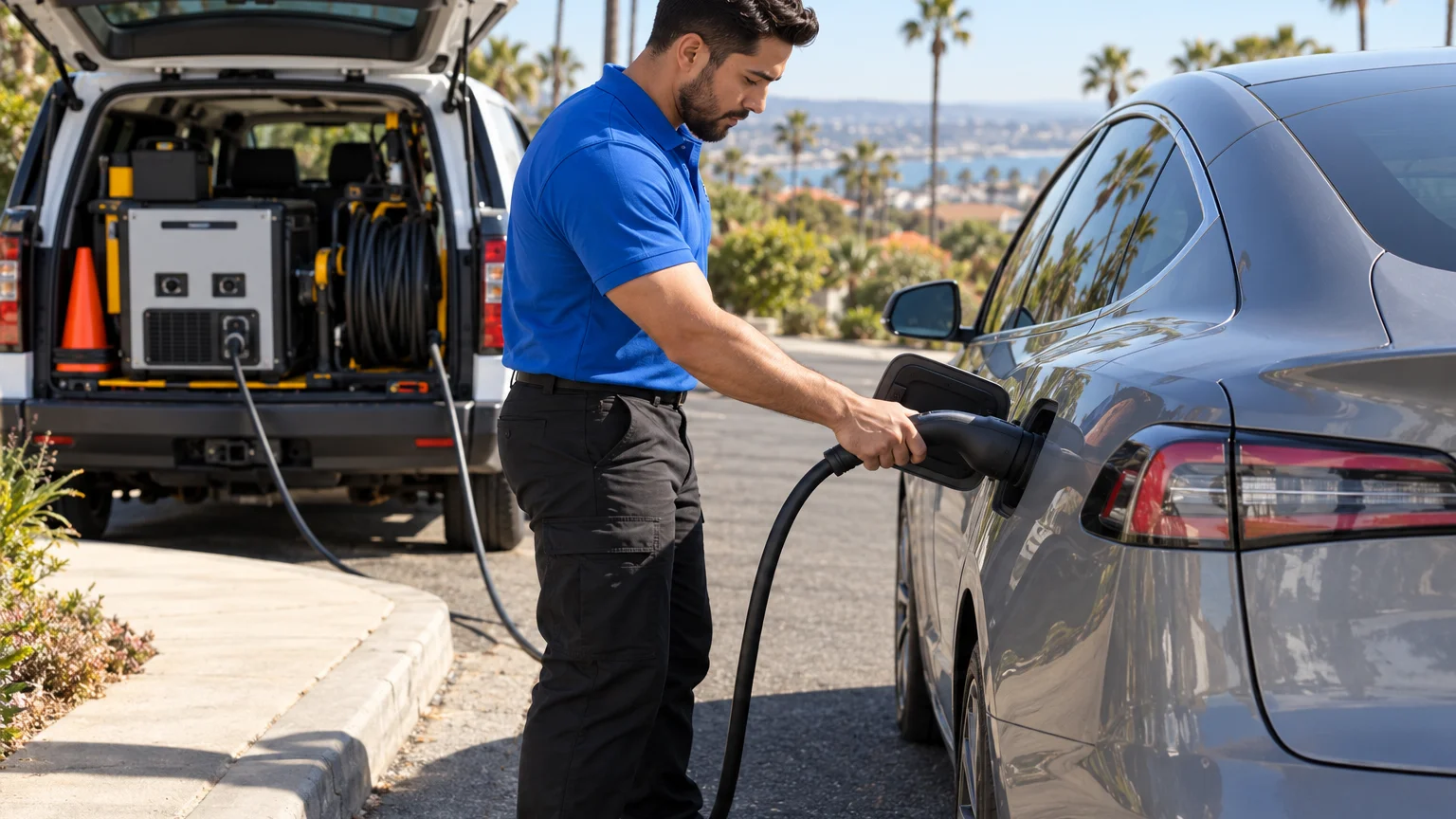
Mobile charging can fit when the main pack is empty, the EV is accessible, and a short rescue charge can reach a suitable charger. The typical rescue charge approved for this site adds 10 to 20 miles of range during 15 to 30 minutes of Level 2 charging. That time describes charging only, not operator arrival.
A tow can make more sense when the EV is damaged, can’t accept a charge, or needs evaluation beyond the roadside. It may also be necessary when the stopping place is unsafe or inaccessible to charging equipment. Follow the vehicle maker’s towing instructions for your exact model.
Orange County had 7,095 public charging ports at the end of 2025, according to the California Energy Commission. The county also had 260,833 registered zero-emission vehicles. A charger appearing on a map still doesn’t confirm current access, compatibility, or availability. Check the charging network before choosing a destination.
Location changes the decision. A curb near Irvine’s office corridors differs from a gated structure. Anaheim resort traffic may limit safe working space. A vehicle near John Wayne Airport may sit within an access-controlled area. Along I-405, freeway safety takes priority over preserving a rideshare shift.
Ask the operator whether the proposed charge can reach a compatible public stall. Also confirm the connector, parking access, and payment method for that stall. Charge Pro OC doesn’t set the operator’s price or promise an arrival time.
Our mobile EV charging service explains the referral option. Drivers using an EV for deliveries may also find the on-site delivery van charging guide useful. The same core choice applies: add enough energy to move, or transport the vehicle.
Record the location before requesting a referral
A precise location helps the independent operator judge access and equipment needs. Don’t send only a city name or a dropped map pin. Pins can land on the wrong side of a freeway, structure, or controlled entrance.
Write down the street address when available. Add the nearest cross street, direction of travel, floor, row, gate, and entrance. For a freeway stop, record the route, direction, nearby exit, and whether you’re on the right or left side. Don’t walk near traffic to find a marker.
For John Wayne Airport, note the specific public area or structure shown in your navigation app. Don’t assume an operator can enter a staging or pickup area. Current access rules weren’t confirmed for this page, so check official airport guidance and tell the operator about any restriction.
In Anaheim, distinguish a hotel entrance from a public street. Around Irvine offices, identify the building and parking level. A garage height limit or locked gate can affect which vehicle can reach you. Report those details without estimating.
Have these vehicle details ready:
- Make, model, and model year
- Connector type, if known
- Displayed range before shutdown
- Exact warning messages
- Whether doors and screens still work
- Collision, tire, or mechanical damage
- Passenger and cargo status
- Parking or access restrictions
Send photos only when you can take them safely. Useful images include the warning display, charge port, parking position, and entrance signs. Keep platform screenshots separate from the roadside request.
Charge Pro OC serves 45 Orange County cities and communities. We connect drivers with licensed, independent local operators. The matched operator evaluates the EV, quotes the work, and performs the physical service. Charge Pro OC doesn’t own rescue equipment, set prices, or provide warranties.
When to call us
Call when your rideshare EV can’t continue and you need an operator to assess mobile charging, low-voltage help, or towing. Call us at (949) 444-0151 and we’ll connect you with a local EV rescue operator.