Your EV is empty, parked at a hotel, and can’t reach another charger. Start by contacting the front desk or valet, confirming access, and recording the car’s exact location. Then a licensed, independent local operator can assess whether an on-site charge or tow fits the situation.
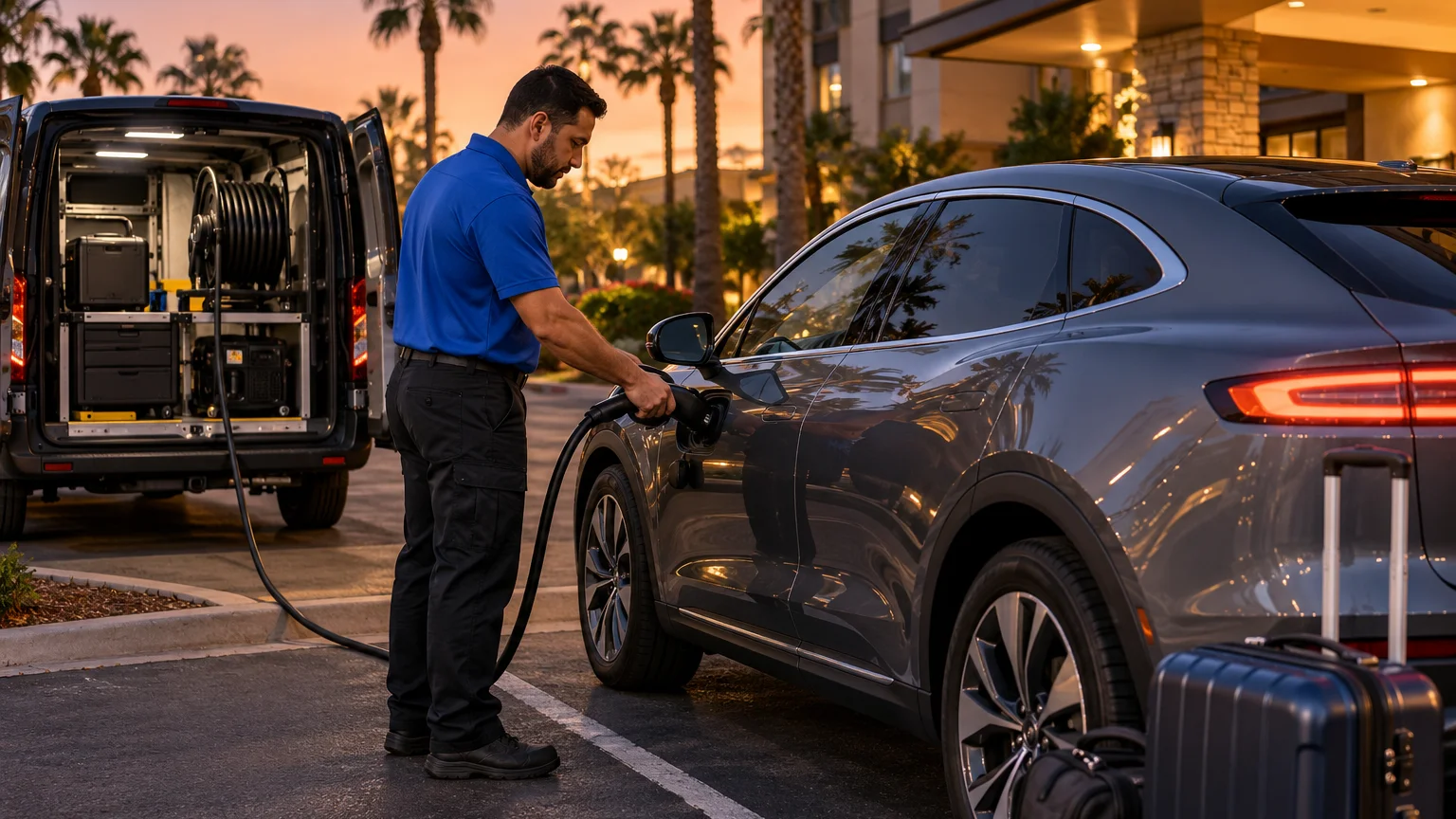
Ask the hotel about service-vehicle access
Call the front desk or visit it before arranging roadside help. Explain that the EV can’t reach another charger and may need an outside service vehicle. Ask who can authorize access and whether that approval must come from security, parking staff, or a valet supervisor.
No single Orange County hotel access policy could be confirmed for this guide. Rules are set by each property. Confirm the current requirements directly with the hotel before an operator travels there.
Give hotel staff the guest name and room number, if applicable. Share the EV’s make, model, color, and parking location. If a valet has the key or key card, ask who will release it. Also ask whether the registered guest must be present when an outside operator arrives.
The setting changes the conversation. An Anaheim resort hotel may place the vehicle in a surface lot or parking structure. A Newport Beach hotel may control the car through a valet garage. An Irvine business hotel may use self-parking behind a ticket gate. Don’t assume the same access process applies across those settings.
Ask these direct questions:
- May an outside EV rescue operator enter the property?
- Which entrance should the operator use?
- Does security need the operator’s name or vehicle details?
- Can the service vehicle stop beside the EV?
- Must a valet or hotel employee accompany the operator?
- Are there parking fees or outside-service rules to address?
Write down the employee’s name and instructions. If possible, ask the hotel to note the authorization on your room or parking record. Charge Pro OC can connect you with an operator, but the hotel controls access to its property.
Confirm the garage, valet area or surface lot
“It’s at the hotel” isn’t a precise service location. Identify whether the car sits in a garage, valet area, loading zone, or surface lot. Then collect enough detail for the operator to find it without searching the property.
For a garage, record the structure name, level, row, space, and nearest elevator. Note which street leads to the correct entrance. A large hotel complex may have separate guest, valet, employee, and event parking entrances. Ask hotel staff which entrance an outside service vehicle may use.
For a valet-controlled EV, don’t rely only on the claim ticket. Ask where the car is physically parked. Confirm whether valet staff will retrieve it, escort the operator, or bring it to an approved work area. If the EV can’t move under its own power, tell them that before anyone attempts retrieval.
A surface lot still needs a clear description. Record the nearest building entrance, lot section, space number, and nearby fixed landmark. Send a dropped map pin if the operator requests one. Avoid descriptions based only on temporary vehicles or crowds.
If the hotel EV charger isn’t working, photograph its screen and connector without blocking other drivers. Copy any displayed message exactly. Don’t assume that a plugged-in car has received energy. Tell the operator when you connected it, what the vehicle displayed, and whether charging ever started.
The California Energy Commission tracks public charging infrastructure, but a charger elsewhere doesn’t help when the EV can’t leave the hotel. For a deeper look at local rescue options, see our guide to mobile EV charging near you in Orange County.
Don’t move, push, or release the vehicle from valet control without permission. First settle where the operator may park and where the assessment may happen.
Check whether the problem is the pack or 12V
An electric car that’s dead at a hotel doesn’t automatically need energy added to its traction pack. The operator needs the vehicle’s recent behavior before selecting equipment or recommending a tow.
Start with what happened before the car stopped responding. Report the last displayed range or battery percentage. Say whether the EV reached the hotel under its own power. Note whether it charged after parking and whether the dashboard showed a charging message, warning, or error.
Next, describe its current condition without guessing at the cause:
- Does the main display turn on?
- Do the doors unlock normally?
- Does the charge-port door respond?
- Can the vehicle enter a drive-ready state?
- Is any warning visible in the car or mobile app?
- Did the hotel charger show that a session began?
- Does the charging connector release normally?
Take photos of warning messages instead of paraphrasing them. Keep the vehicle identification details and owner’s manual available. Follow the manufacturer instructions for that specific model. Don’t attempt an unfamiliar low-voltage jump procedure based on advice for another EV.
Pack depletion and a low-voltage problem call for different next steps. A charging connector also can’t solve every no-start condition. Charge Pro OC’s mobile EV charging service is intended for situations where adding usable range at the vehicle is the appropriate response. The matched operator decides what equipment fits after reviewing the car and access conditions.
Tesla owners should be especially precise about the sequence. Tesla’s Model Y manual says that after range is exhausted, the low-voltage battery loses support and needs an external power supply before the high-voltage battery can charge. That statement applies to the documented Model Y condition. Don’t extend it to every EV without checking the correct manual.
If the cause remains unclear, say so. An accurate “not confirmed” helps more than a confident guess.
Record the posted clearance and parking restrictions
Before requesting mobile EV charging at hotel parking, inspect the route to the car. Photograph every posted clearance sign from the property entrance to the parking space. Record the exact wording and measurement rather than relying on memory.
No clearance for a specific Anaheim, Newport Beach, or Irvine hotel could be confirmed from the approved research. Ask the property for its current posted clearance. The hotel should also confirm whether a service vehicle can pass through each gate, ramp, and controlled entrance.
Clearance isn’t the only access detail. Look for posted restrictions covering vehicle size, loading areas, reserved spaces, valet zones, and outside vendors. Photograph signs near the EV and at the garage entrance. Don’t interpret a restriction for the operator. Send the image and let the hotel explain what it permits.
Also document the working space around the vehicle. Tell the operator whether another car is parked beside it, whether the nose faces a wall, and whether a cable can reach the charge port without crossing a traffic lane. Mention tight turns, steep ramps, gate arms, ticket machines, and locked floors.
Ask how the operator will enter and exit. Some situations may require a parking ticket, room-key access, or staff escort. Don’t promise that the hotel will waive parking or access charges. Confirm whether any fee applies, who sets it, and how it must be paid.
If the hotel won’t allow a service vehicle into the garage, ask what option it authorizes. That could mean a different work area or arranging a tow, but the hotel must provide the property instructions. Don’t move a disabled EV into an unauthorized area.
Share the photos and written directions before service begins. Good access information helps the operator determine whether on-site work is practical.
Compare an on-site charge with a tow
Once access and the vehicle’s condition are clear, compare an on-site charge with recovery by tow. The right choice depends on the confirmed fault, the hotel’s authorization, the physical workspace, and the destination after the car can move.
An on-site charge may fit when the traction pack is depleted, the EV can accept charging, and the hotel allows the operator to work beside it. A typical rescue charge adds 10 to 20 miles of range during 15 to 30 minutes of Level 2 charging. That describes charging time, not operator arrival time. Actual usable range still depends on the vehicle and its condition.
That added range may let the driver reach a compatible station. Before choosing that route, identify a destination and confirm its connector fits the vehicle. Don’t rely on an unverified hotel charger or assume a station remains available.
A tow may fit better when the EV won’t accept a charge, the cause isn’t confirmed, or the hotel won’t allow service beside the car. Towing may also be the practical option when garage access prevents suitable equipment from reaching the EV. The operator should review the vehicle’s towing instructions before movement.
Tesla’s roadside policy handles a depleted battery through transportation, not an on-site charge. That transportation is paid rather than financially covered for battery depletion. Other manufacturer or membership terms weren’t confirmed for this page, so check the current policy tied to your vehicle.
Charge Pro OC doesn’t set the price for either option. The independent operator quotes and bills the driver directly. Ask what the quote covers before approving service. Hotel parking or access charges are controlled separately by the property and should be confirmed with hotel staff.
Our out-of-charge recovery service can connect you with a licensed local operator when the vehicle can’t reach a charger. Compare the available paths based on access, diagnosis, and where the EV needs to go.
When to call us
Call when your hotel has confirmed access and the EV can’t reach another charger. We’ll connect you with an independent operator who can review whether mobile charging or recovery by tow fits the situation.
Call us at (949) 444-0151 and we’ll connect you with a local EV rescue operator.