If you’re searching for AAA mobile EV charging in Orange County, confirm the benefit before waiting. Mobile charging programs can differ by market, while a tow or 12V jump solves a different problem.
What drivers mean by AAA mobile EV charging
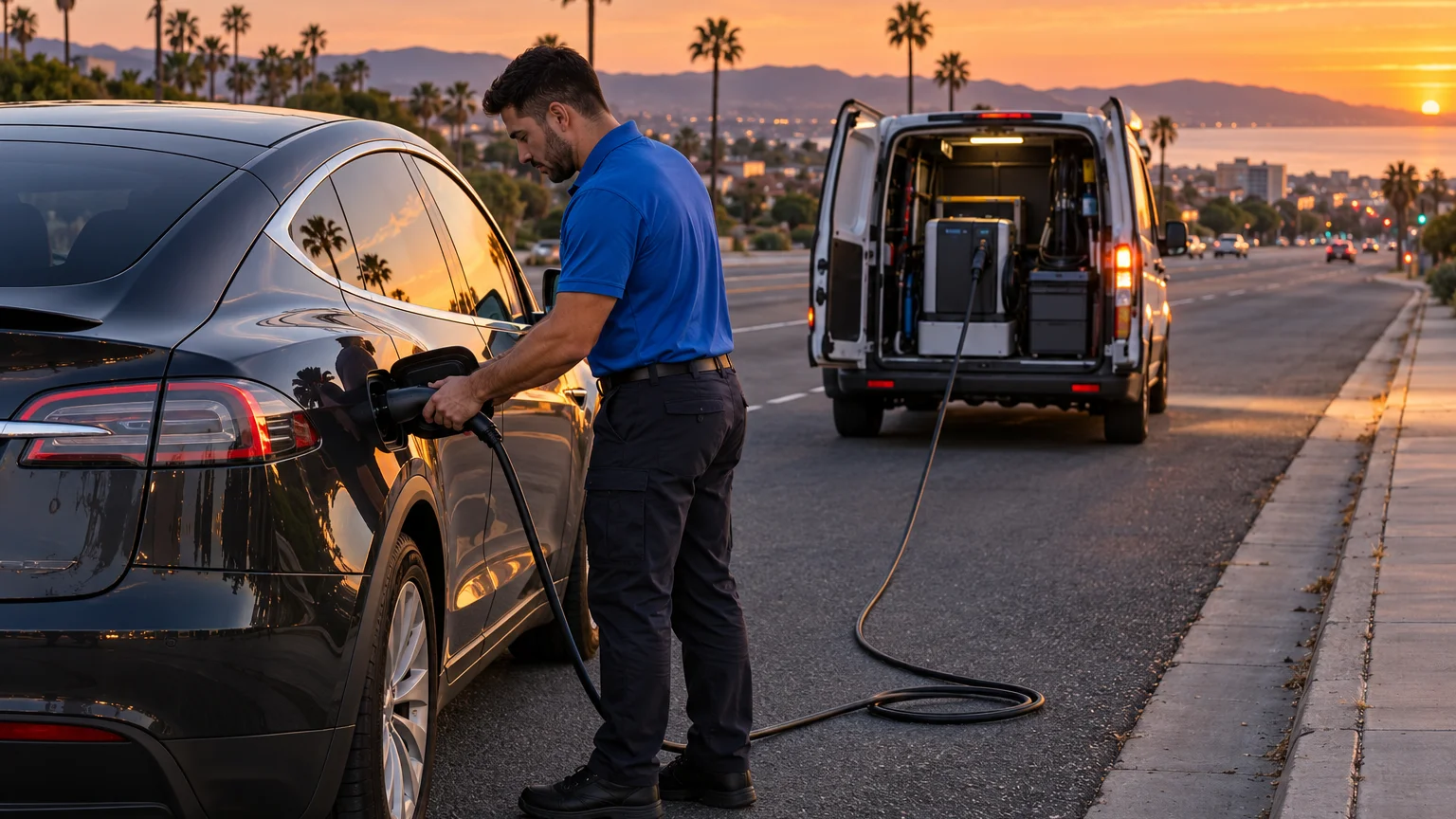
Drivers usually mean one specific service: a roadside truck brings usable energy to an EV with an empty traction battery. The goal is enough range to reach a working charging station or another suitable destination.
That isn’t the same as ordinary EV roadside assistance. A roadside plan might offer towing, tire help, lockout help, or a 12V jump without bringing energy for the main battery. Those services can still help, but they don’t answer the same need.
The distinction matters when comparing AAA or mobile EV charging. Ask these questions when requesting help:
- Is roadside charging available at my current location?
- Will the responding vehicle carry EV charging equipment?
- Is the planned service a charge, a tow, or a 12V jump?
- Does the operator support my vehicle and connector?
- Where would a tow take the vehicle?
- What charges or membership limits apply?
Don’t assume the phrase “EV roadside assistance” means an AAA EV charging truck will appear. The approved claims record available for this article doesn’t confirm that AAA currently sends mobile charging vehicles throughout Orange County.
For a closer comparison, read AAA or mobile EV charging when the battery is empty. If you need energy brought to the parked vehicle, our mobile EV charging referral service connects drivers with licensed, independent local operators.
What AAA’s California EV page actually lists
A current, verified description of an Orange County AAA mobile-charging benefit isn’t present in this site’s approved claims record. That means we can’t confirm that AAA’s California offering includes an on-site charge, which membership levels might include it, or whether Orange County has equipped charging trucks.
Older articles and pages from other AAA regions aren’t enough. A program offered in another state or metro doesn’t establish coverage in Anaheim, Irvine, Santa Ana, Huntington Beach, or South County. Mobile programs also can change while general roadside benefits remain available.
Before you wait, contact AAA through the method shown on your membership materials. Give the representative your exact location, vehicle model, remaining charge, and dashboard condition. Then ask the representative to name the service being assigned.
A clear answer should distinguish among:
- A mobile charge delivered beside the vehicle
- Transportation to a public charging station
- A jump for the low-voltage battery
- A standard tow for another mechanical problem
Ask where a tow would end. “Nearest suitable charger” and your preferred charging site may not mean the same place. Also confirm any membership limits and operator charges directly with AAA. No verified AAA price or Orange County mobile-charging fee appears in the approved ledger, so this article won’t supply one.
Orange County had 210,842 registered battery-electric vehicles as of December 31, 2025, according to the California Energy Commission. That demand doesn’t prove any particular roadside benefit exists. It does explain why drivers need precise answers instead of broad EV language.
Charging truck, tow to a stall, or a 12V jump
These three responses address different failures. The wrong request can leave the original problem unchanged.
A charging truck is relevant when the traction battery lacks enough energy to drive. The approved rescue figure for a Level 2 roadside charge is 10 to 20 miles of range during 15 to 30 minutes of charging. That describes charging time, not operator arrival time. Actual compatibility and the result still need confirmation with the responding operator.
A tow moves the vehicle instead. It can make sense when charging beside the car isn’t available, the location isn’t safe for service, or the EV has another fault. Confirm the destination and charging access before accepting that plan. A charger shown on a map might not be usable by your vehicle when you reach it.
A 12V jump addresses the smaller low-voltage battery. It doesn’t refill an empty traction pack. A dark screen, locked controls, or a vehicle that won’t wake can point toward a low-voltage issue. A battery gauge at empty points toward an out-of-charge problem. Some failures can present overlapping symptoms, so describe the dashboard and recent warnings accurately.
This distinction is especially relevant to AAA roadside assistance for Tesla vehicles. Tesla’s own roadside policy answers a depleted battery with transportation, not on-site charging. That transportation isn’t financially covered for running out of charge. Once a Model Y’s range is exhausted, its low-voltage battery can also lose support and require external power before the high-voltage pack can charge.
Our guide comparing an AAA EV charging truck with a local OC operator goes deeper into that service choice.
OC places a tow-to-stall plan still leaves you sitting
A tow is movement, not restored range. It only solves the problem if the destination has a compatible, accessible, working stall.
Consider SR-241. Orange County Freeway Service Patrol’s published coverage area doesn’t list SR-241, SR-73, SR-133, or SR-261. That wording matters. It doesn’t prove assistance never reaches a toll road, but it means drivers shouldn’t treat the published FSP routes as a toll-road charging plan.
FSP also doesn’t list EV charging among its services. During its operating hours and on patrolled segments, the listed outcome for a depleted EV is a tow to a CHP-designated drop zone. Service isn’t guaranteed. A drop zone isn’t necessarily a charging location.
Beach parking creates another gap. A vehicle can be empty inside a Huntington Beach, Newport Beach, Laguna Beach, Dana Point, or San Clemente lot. Towing it away may require property access, a clear destination, and a plan for the driver. If a usable charger is elsewhere, moving the car merely changes where the waiting happens.
HOA garages present a different access problem. A tow vehicle or mobile operator may need gate entry, garage clearance, and permission to reach the parked EV. California Civil Code 4745 limits governing documents that prohibit or unreasonably restrict charging-station installation. That law doesn’t guarantee a roadside vehicle can enter a particular private garage.
Before approving a tow-to-stall plan, confirm the stall’s connector, access, and operating status. Orange County had 7,095 public charging ports as of December 31, 2025. The county also had 36.8 zero-emission vehicles per public port. A countywide count doesn’t guarantee the specific stall you need will be open.
A local operator as backup, not a rival speech
AAA membership and a local mobile operator don’t have to compete. They solve different parts of the roadside problem, depending on what is available at that moment.
Start with the benefit you’ve already paid for. Ask AAA whether your location qualifies for an actual mobile charge. If the answer is a tow, ask where the EV will go and whether that destination works for your connector. If the answer is a 12V jump, make sure the issue isn’t simply an empty traction pack.
A local operator becomes a practical backup when on-site charging is what you need but your membership response doesn’t include it. Charge Pro OC is a referral service. We don’t own a charging truck, dispatch our own technicians, set operator prices, or perform roadside work. We connect drivers with licensed, independent local EV rescue operators. The driver contracts with and pays the matched operator directly.
When requesting a connection, share the details that shape the job:
- Your precise location and parking level
- Your EV’s year, make, and model
- The connector used by the vehicle
- The dashboard state and remaining range
- Gate, garage, or property-access instructions
- Whether the car can shift or roll
Ask the operator to confirm compatibility, the proposed service, and the quoted price before work begins. Charge Pro OC doesn’t publish a universal rate because the independent operator sets the price.
If the main battery is empty, see how out-of-charge EV recovery differs from a low-voltage jump. The useful choice is the one that matches the failure, the location, and the service actually available.
When to call us
Call when your EV is stranded and you need a local operator who may be able to bring charging equipment to the vehicle. This can help when AAA hasn’t confirmed mobile charging or a tow-to-stall plan doesn’t fit your location.
Call us at (949) 444-0151 and we’ll connect you with a local EV rescue operator.