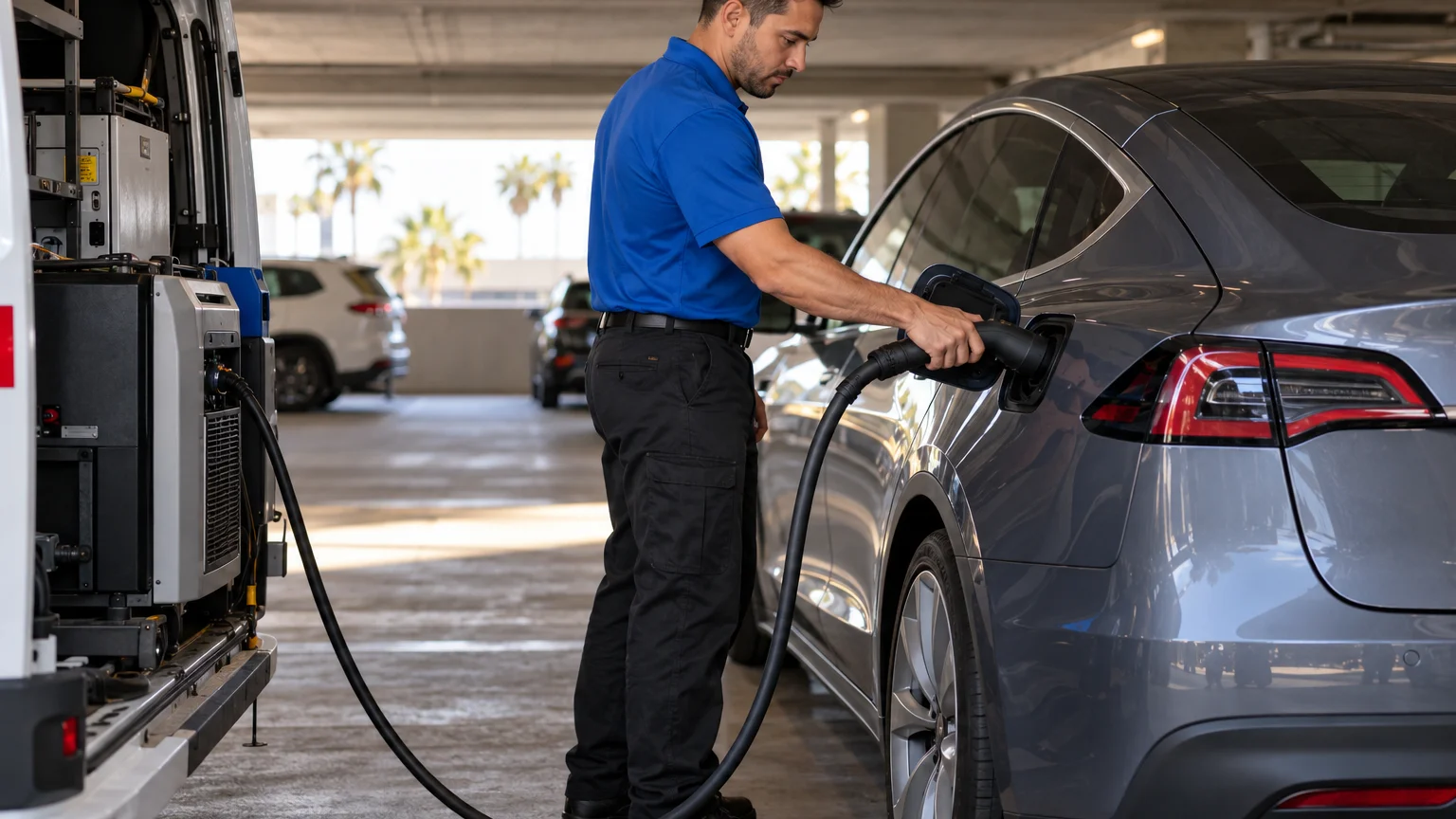
A mobile EV charging vehicle may fit inside a Newport Beach condo garage, but the posted clearance decides that first. The operator also needs to confirm the route, stall, gate access, and available working space before driving out.
Can a mobile charging vehicle fit underground?
There isn’t one answer for every underground garage. The service vehicle must fit below the lowest clearance along the complete route. That includes the entrance and any lower point between the street and your stall.
Don’t assume the number posted outside covers every interior area. Look for additional clearance signs near ramps, turns, pipes, beams, or level changes. Read each sign and photograph it clearly. The operator can compare those posted limits with the vehicle planned for your call.
Charge Pro OC can’t confirm a local operator’s vehicle height without asking that operator. We also couldn’t confirm one standard clearance for Newport Beach condo garages. Building management or the HOA can confirm the garage’s posted limit and any known lower points.
A smaller service vehicle may clear a structure that a flatbed can’t enter. That doesn’t mean every mobile charging vehicle will fit. Vehicle dimensions and equipment arrangements differ. The safe answer comes from comparing the actual service vehicle with the posted clearance.
A garage entrance can also be wide enough but still have a difficult route. Tight turns, steep transitions, columns, and narrow aisles can affect access. Send photos instead of describing the route from memory.
The phone check should happen before anyone drives out. The operator can then decide whether on-site charging appears workable or another recovery plan is needed. Our guide to how mobile EV rescue trucks work explains the broader charging process.
Photograph the clearance and route
Start at the entrance your vehicle used. Take a clear photo showing the full clearance sign. Then photograph any posted lower clearance inside the structure.
Follow the route from that entrance to the dead EV. Capture ramps, sharp turns, hanging pipes, low beams, gates, columns, and narrow sections. A short sequence of useful photos is better than one distant image.
Include the EV and its surroundings. The operator needs to see whether another vehicle can approach the charge port. Show the adjacent stalls, wall, column, wheel stops, and driving aisle. If another parked car blocks the useful side, mention whether building management can contact its owner.
Write down these details before calling:
- The garage entrance used
- The posted clearance at that entrance
- Any lower posted clearance inside
- The parking level and stall number
- The EV’s year, make, and model
- Which side or corner holds the charge port
- Whether the car wakes, unlocks, or shifts
- Any warning shown on the screen or app
Don’t report a clearance from memory. A photograph lets the operator read the sign directly. Don’t measure hanging equipment yourself when building management already controls that information. Ask management to confirm any unclear or missing sign.
These details help separate an empty traction battery from a low-voltage problem. An EV that won’t wake may need different help than one displaying an empty main battery. Our dead EV charge, jump, or tow guide explains that decision.
Confirm gate, fob, and HOA access
Physical clearance is only half the access check. Many Newport Beach condo garages have controlled entrances, resident fobs, guest procedures, or staff-managed gates. The operator needs a legal and practical way to enter.
Tell the operator whether the gate opens by fob, remote, keypad, call box, or staff approval. Confirm that your access method can admit a service vehicle. A resident fob that opens the gate for a passenger car may not settle whether management permits outside service vehicles.
Identify the person who can authorize access. That might be building management, an HOA representative, security, or another person designated by the property. Charge Pro OC can’t confirm a particular property’s rules. The person managing that garage must explain them.
Ask management these direct questions:
- May a mobile EV charging vehicle enter the garage?
- Which entrance must it use?
- Who will open the gate?
- Are service vehicles required to check in?
- Is there a loading or staging area near the stall?
- Can management reserve enough working space?
- Does the garage have any lower interior clearance?
Also share any time-sensitive access issue with the operator. Don’t assume staff will be present or that a guest entrance stays available. Confirm the current arrangement directly with whoever controls the property.
Charge Pro OC connects drivers with licensed, independent local EV charging professionals. The matched operator quotes and bills the driver directly. The quote and garage-access review should happen by phone before the operator heads toward the property.
Choose charging or towing based on access
On-site charging can avoid moving the EV when a suitable service vehicle can reach the stall. The operator still needs room to position safely and connect compatible equipment. Clearance alone doesn’t establish that the job is possible.
A flatbed may be too tall for an underground structure even when a smaller service vehicle fits. If the tow vehicle can’t enter, the EV may first need to reach an accessible loading point. Don’t push, pull, or tow it without following the vehicle manufacturer’s instructions.
A dead EV may not shift into neutral or release its parking brake normally. Some vehicles also need low-voltage power before other systems respond. The exact procedure depends on the model. Check the owner’s manual and tell the operator what the car is doing.
If mobile charging is possible, the approved typical rescue charge is 10 to 20 miles of range during 15 to 30 minutes of Level 2 charging. That’s charging time, not an arrival estimate. The actual result can depend on the vehicle and conditions.
That limited charge is meant to help the driver reach a suitable charging point. It isn’t a full recharge. Newport Beach has a Tesla Supercharger at 4241 MacArthur Boulevard and an Electrify America site at Fashion Island, 401 Newport Center Drive. Compatibility and current availability should be checked before choosing a destination.
If garage access prevents charging, discuss recovery choices with the operator and property manager. Our mobile charge or tow comparison covers the main differences.
Don’t ignore private-lot towing rules
A dead EV in an assigned condo stall may seem protected from towing. That shouldn’t be assumed. Garage rules, stall rights, and the property’s towing authorization can affect what happens next.
California Vehicle Code 22658 governs private-property towing. One authorized towing route uses signs at every entrance. The signs must be at least 17 by 22 inches, use lettering at least one inch high, and state that unauthorized vehicles will be removed at the owner’s expense. They must also list local traffic law enforcement and each authorized towing company’s name and phone number.
The statute contains other towing triggers and detailed procedures. It doesn’t mean every dead EV can remain indefinitely. Your lease, deed, assigned-stall rights, and HOA rules may also matter. Ask building management whether the vehicle may remain while rescue access is arranged.
If a tow truck has coupled the EV but hasn’t removed it from the property, the owner or owner’s agent may request its release. The towing company must release it before removal and transit, but the vehicle owner must immediately move it to a lawful location. The company may charge no more than half its regular towing charge at that stage.
Don’t wait for a towing dispute to begin. Tell management that the EV is disabled, document the stall, and ask what authorization is needed for a rescue vehicle. Keep written messages and photograph posted towing signs.
When to call us
Call when your EV is stranded in an Orange County underground garage and the clearance, gate, and stall access need review. Charge Pro OC will connect you with a licensed local operator who can discuss the vehicle, quote the work, and confirm whether the planned service vehicle can enter.
Call us at (949) 444-0151 and we’ll connect you with a local EV rescue operator.